
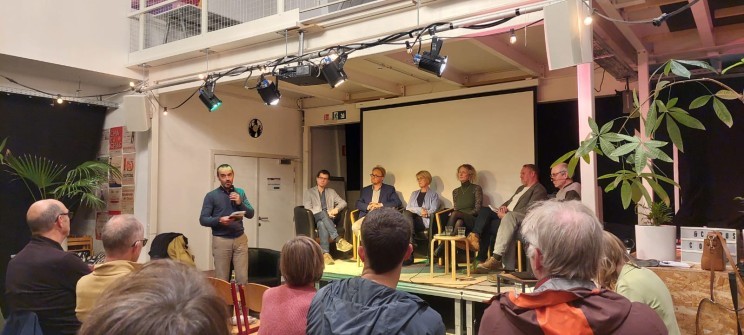
Op woensdag 12 november brachten LEUC/LEUK, Leuven Mindgate, Leuven 2030 en Europa Direct in Leuven beleidsmakers, onderzoekers en lokale change makers samen voor een rijkgevuld debat over de toekomstige Circular Economy Act (CEA), en vooral het stedelijke perspectief: hoe kunnen lokale initiatieven bijdragen aan systemische verandering?
(For English translation: see end of Dutch text)
Sinds het begin van Ursula von der Leyens tweede mandaat als Commissievoorzitter in 2024 wordt er met belangstelling uitgekeken naar de Circular Economy Act, een sleutelelement van het Europese duurzaamheidsbeleid. De publieke consulatie is net afgelopen en wijst op een sterke belangstelling voor het initiatief. Recente geopolitieke verschuivingen onderstrepen het belang van duurzaam materiaalgebruik voor strategische autonomie. Vlaanderen heeft zich, samen met een aantal steden zoals Leuven en Mechelen, ontpopt tot pioniers van de circulaire economie (CE). Leuven en Mechelen hebben hun eigen circulaire strategie uitgewerkt en betrekken burgers en bedrijven actief betrekken bij elke stap.
Een aantal inzichten die eruit sprongen:
De circulaire economie is belangrijk voor ecologische, economische, en sociale duurzaamheid. Stefano Soro (DG GROW) benadrukte dat de CEA zowel een antwoord moet bieden op geopolitieke onzekerheden als op ecologische grenzen. Het marktpotentieel voor gerecycleerde materialen blijft onderbenut, mede door fragmentatie. Harmonisatie van afvalverwerkingsnormen, het creëren van gunstige randoorwaarden, en het verstevigen van de business case moeten hier verandering in brengen.
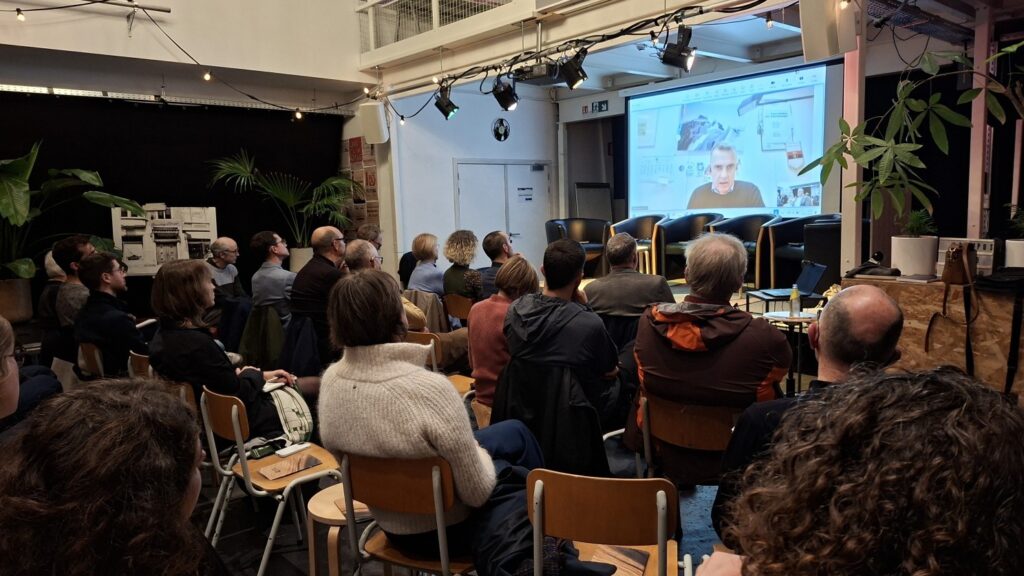
Grondstoffenautonomie wordt essentieel. MEP Bruno Tobback wees op de absurde situatie waarin waardevolle materialen Europa verlaten als afval, om later dure virgin grondstoffen weer in te voeren. Een meer circulaire aanpak is niet alleen verstandig—ze is noodzakelijk. Maar meer werk is nodig om alle neuzen in dezelfde richting te krijgen, want de realiteit op vlak van circulariteit en recyclage verschilt nog heel erg van lidstaat tot lidstaat.
Upscaling blijft de grote uitdaging. Zoals Jan Mertens (Leuven Circulair) aangeeft: steden hebben enorm veel pilootprojecten, maar de stap naar schaalvergroting blijft moeilijk. Tegelijk moeten we durven kijken naar sufficiëntie: minder verbruiken, langer gebruiken, meer herstellen.
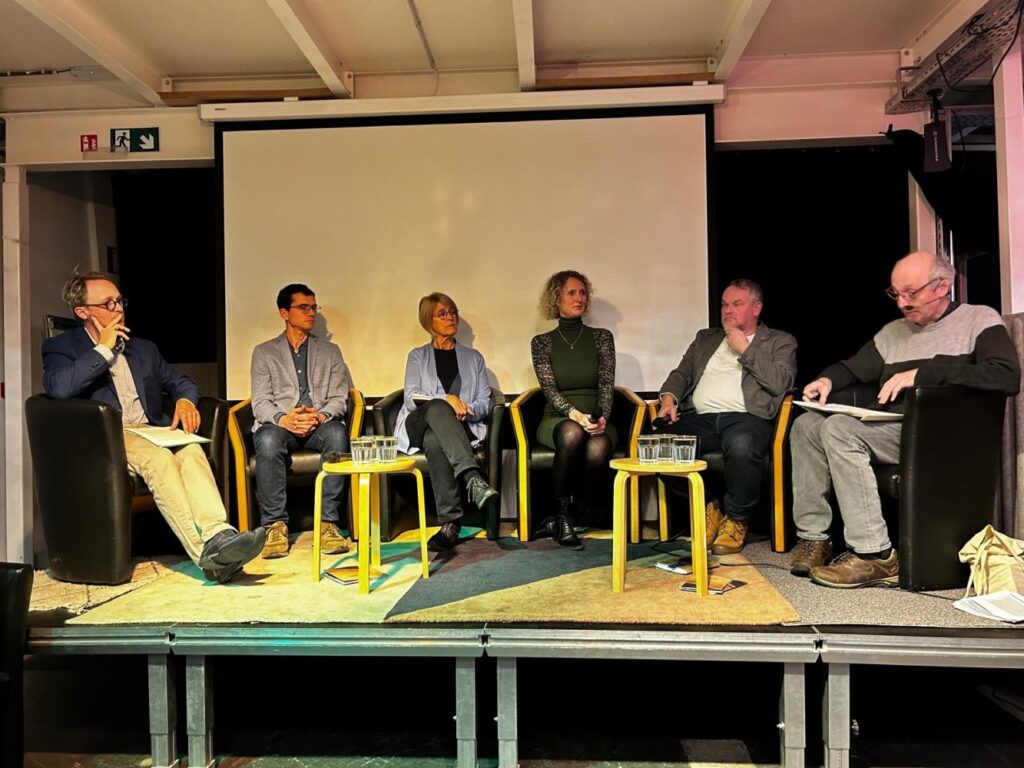
Foto: Nick Meynen, Luc Allaerts, Brigitte Mouligneau, Kira Van den Ende, Patrick Princen en moderator Jan Mertens
Hebben we wel de juiste vragen gesteld? Kira Van den Ende (BBL) herinnerde ons eraan dat reductiedoelstellingen centraal moeten staan. Minder materiaalgebruik hoeft onze levenskwaliteit niet te verlagen—integendeel.
Kennis en experimenten als versnellers. Luc Alaerts (KU Leuven) benadrukte het belang van interdisciplinair onderzoek en initiatieven zoals de Leuven 2030 Urban Lab om praktijkvragen te koppelen aan wetenschappelijke oplossingen.
Lokale ecosystemen zijn aan het groeien. Nick Meynen (Leuven 2030) gaf aan hoe Leuvense organisaties kijken naar een geïntegreerd stedelijk grondstoffencentrum. Publieke aanbestedingen, bijvoorbeeld in de bouwsector, kunnen een grote hefboom vormen.
Steden kunnen pionierswerk verrichten. Patrick Princen (Mechelen) ziet een omslagpunt aankomen: stijgende grondstoffenprijzen zullen de circulaire transitie onvermijdelijk maken, niet om morele maar om economische redenen. De aanwezige kennis, urgentie, en goede will stemden hem hoopvol – maar voor sommige aspecten, zoals regelgeving rond de levensduur van producten, is een Europese aanpak noodzakelijk.
Een systemische benadering en voldoende nadruk op implementatie. Brigitte Mouligneau (Vlaanderen Circulair) benadrukte het belang van experimentatie in publiek aankoopbeleid en de financiële ondersteuning van lokale netwerken en initiatieven in de sociale en circulaire economie. De hoge mate van creativiteit bij jonge circulaire ondernemers stemde haar hoopvol.
En opnieuw: trots op wat lokale samenwerking al heeft opgeleverd. Zoals Bruno Tobback het verwoordde: we willen sneller gaan, ja, maar de vooruitgang van de voorbije tien jaar is reëel. Leuven toont aan dat circulaire verandering een gezamenlijk project kan zijn—waardoor met rasse schreden vooruitgang gemaakt kan worden.
English translation
The EU Circular Economy Act: Cities and regions as drivers of change
Since the start of Ursula von der Leyen’s second term as President of the European Commission in 2024, there has been growing anticipation around the Circular Economy Act, a key element of Europe’s sustainability agenda. The public consultation has just concluded and shows strong interest in the initiative. Recent geopolitical shifts underscore the importance of sustainable material use for strategic autonomy. The region of Flanders, and cities such as Leuven and Mechelen, have emerged as a pioneer in the circular economy. Leuven and Mechelen have developed their own circular strategies and actively engage citizens and businesses in every step of the process.
On Wednesday 12 November, we brought policymakers, researchers and local changemakers together in Leuven for an in-depth debate on the upcoming Circular Economy Act (CEA), with a particular focus on the urban perspective: how can local initiatives contribute to systemic change?
🔍 A number of insights that stood out:
The circular economy is essential for ecological, economic and social sustainability. Stefano Soro (DG GROW) stressed that the CEA must be a response to both geopolitical uncertainty and ecological limits. The market potential for recycled materials remains underutilised, partly due to fragmentation. Harmonising waste-treatment standards, creating enabling conditions, and strengthening the business case along the way are key objectives of the upcoming initiatives.
Resource autonomy is becoming essential. MEP Bruno Tobback pointed to the absurd situation in which valuable materials leave Europe as waste, only for expensive virgin raw materials to be re-imported later. A more circular approach is not only sensible—it is necessary. But getting everyone aligned remains a challenge, as the reality of circularity and recycling varies significantly from one Member State to another.
Upscaling remains a major challenge. As Jan Mertens (Leuven Circulair Platform) explained: cities have launched countless pilot projects, yet moving from pilots to large-scale implementation remains difficult. At the same time, we need to dare to embrace sufficiency: consuming less, using products longer, repairing more.
Have we been asking the right questions? Kira Van den Ende (BBL) reminded us that reduction targets must take centre stage. Lower material use does not have to reduce our quality of life—quite the opposite.
Knowledge and experimentation as accelerators. Luc Alaerts (KU Leuven) emphasised the importance of interdisciplinary research and initiatives such as the Leuven 2030 Urban Lab, which link practical challenges to academic expertise.
Local ecosystems are taking shape. Nick Meynen (Leuven 2030) explained how organisations in Leuven are exploring the creation of an integrated urban resource centre. Public procurement, particularly in the construction sector, can serve as a major lever.
Cities can be pioneers. Patrick Princen (Mechelen) sees a coming tipping point: rising raw material prices will make the circular transition unavoidable—not for moral reasons, but for economic ones. The knowledge, urgency and goodwill present today make him hopeful—though some aspects, such as regulation on product life extension, will require a European approach.
A systemic approach and strong focus on implementation. Brigitte Mouligneau (Vlaanderen Circulair) stressed the importance of experimentation in public procurement and the financial support of local networks and initiatives in the social and circular economy. The high level of creativity among young circular entrepreneurs gives her confidence.
And again: pride in what local collaboration has already achieved. As Bruno Tobback put it: yes, we want to move faster, but the progress made over the past decade is real. Leuven shows that circular transformation can be a shared endeavour—allowing us to make rapid progress.
