
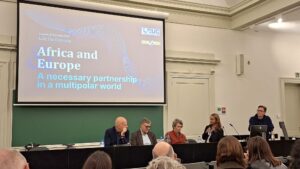
On Thursday 15 October 2026 Leuven-Europa-Club and Minos Leuven had the joy of jointly hosting a panel debate on the future of Africa-EU relations.
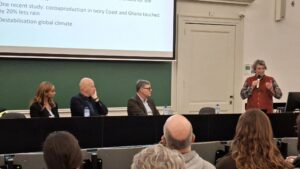
💡 Loïc De Cannière, impact investor with substantial experience in microfinance and agrifood in Africa, presented the ‘economic pentagon’ of Africa: demography, employment, migration, poverty and climate – five key determinants of Africa’s course over the next decades. Agriculture is a major source of employment; 9 out of 10 extreme poor live in Africa, and extreme poverty continues to rise. The recently published Afrobarometer suggests that 35% of young people are seriously considering migrating – though mostly to other African countries. Loïc underlined the strong job creation potential in agriculture and natural resources management, and argued that Africa’s young population will drive innovation and creativity
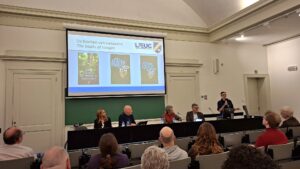
💡 John Vandaele, journalist at MO* magazine, highlighted the African rainforest’s role as a green lung for the world. Population growth is increasing pressure on the rainforest, whose wood is a key source of energy, construction material and income for local people. John called on the international community to step up efforts to support the preservation of the rainforest, by investing in local development and alternative job opportunities – which would also serve the EU’s interests (a more stable climate, less migration, better access to natural resources, and a stronger role of the EU in the world).
💡 Paulus Geraedts, team leader at DG INTPA, provided a brief overview of the EU’s new approach to international relations: the Global Gateway approach, moving from a relationship based on charity to a relationship based on mutual benefits. He highlighted the historical decline (-23%) in official development aid in 2025 and the broader overhaul in approaches to development. The Global Gateway strategy focuses on collaborations with local banks and investors by de-risking investment, a mix of grants and concessional loans, the ‘Team Europe’ approach with strong cooperation between different partners (EU, EIB, EBRD, member states, development agencies, financial institutions, local authorities, all relevant ministries, private sector, civil society, and export credit agencies), with technical assistance to ensure a working regulatory environment (business environment, macroeconomic and financial stability, governance, …) in line with EU values and a “one-stop” Investment Hub for potential investors.
The panel was followed by a lively debate, skillfully moderated by Mesgana Giovanni. Participants asked questions about opportunities for an African middle class to emerge, the role of European universities to support high value job creation, strategies for sustainable growth in Congo and to ensure more local value creation in the natural resources sector.
